Showing posts with label education. Show all posts

Thursday, August 27, 2015

Governor Kasich, Abolishing the Metaphorical Teacher's Lounge Would Be Even Worse than Banning the Real One


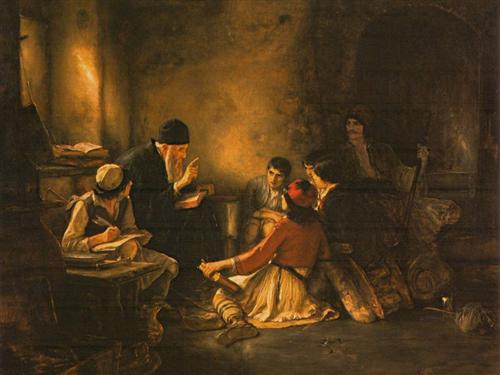
The Secret School - Nikolaos Gyzis
The Secret School, Nikolaus Gyzis

 
 Recently, Ohio governor and Republican presidential hopeful John Kasich raised some ire over a comment he made at an education conference in New Hampshire. The unabashedly anti-public-education governor said that if he were King of America, he would "abolish all teachers' lounges, where they sit together and worry about 'woe is us.'"

Kasich's spokesman, Rob Nichols, had this piece of snark to say in response to those who took offense:

He thinks teachers have far more support in their communities than they sometimes give themselves credit for and they shouldn't pay attention to the small number of pot-stirrers in their ranks who try to leverage problems for political gain. Anyone thinking he was making a comment on buildings or school architecture or space usage might need to look up the word "metaphor" in a dictionary.
Emphasis added by me, because I was pretty well stunned by that last zinger of a sentence. 

Note to Governor Kasich: If you want to try to defend your fairly outrageous statement, calling it a metaphor is not the way to do it. Yes, we know what "metaphor" means, and no, we didn't think that you were really talking about architecture. We get it: It is teachers' voices that you object to, not the teacher's lounge. 

I mean, let's unpack this metaphor. If Kasich is not talking about the brick-and-mortar space, then what is he talking about? What is the metaphorical teachers' lounge that he'd like to abolish?

Indeed, it's not the literal architectural space that bothers him: It's the gathering, the meeting of ideas, the organizing together. It's the outcry over poorly designed, misused standardized tests; it's the many thoughtful critiques of the new teacher evaluations. It's the multitude of blogs, Facebook groups, and forums that have sprung up in response to worsening working conditions and low morale. It's the collective yearning to break free from education reforms that undermine teaching and learning.

Of course Governor Kasich would prefer that teachers stop talking about what's really going on in their classrooms so that the narrative of education reform can continue, unhindered by teachers' lived realities. The metaphorical teachers' lounge is far more important than the literal one.

If Kasich really wants to do damage control, he needs to offer an apology. The "it was a metaphor" defense makes his statement worse, not better.

Thursday, November 20, 2014

A parent's perspective on school reform and accountabilty.


File:School of Athens Raphael detail 03.jpg
Raphael, School of Athens (detail)
                               
When I was a high school math teacher, I kept an eye on the educational trends that influenced what happened in my classroom, and I had some pretty strong opinions about curriculum and policy. Now that I'm a stay-at-home mother of a child in public school, I am more concerned than ever about what's happening in the schools.

We live in Prince George's County —  the underdog of the Washington metro region —  and we want to stay here. We love our community. Though I'm pleased with the local elementary school our son attends, I am eager for the struggling schools in the county to improve. If Prince George's County is going to boost its reputation, the public schools must become a viable option for families who care about education.

But I am worried about the stories that I'm hearing from teachers.

The new teacher evaluation formula mandated by the state of Maryland heavily emphasizes both a data tracking requirement called Student Learning Objectives and, beginning in the 2016-2017 school year, standardized test scores. I am concerned that the increased emphasis on standardized testing comes at a high cost, not only in terms of dollars spent, but in time, energy, and morale. Moreover, the paperwork burden on teachers, as a result of a hyper-focus on data and high stakes testing, has become overwhelming.

One of my friends is considering leaving the teaching profession after her second year. She says that the time in the classroom is "awesome," but the paperwork and other aspects of dysfunction in the school district's bureaucracy may drive her away from teaching. Another teacher friend told me that she cries on her way home from work nearly every day. When I asked one highly regarded teacher about the amount of paperwork the county requires, she told me that the burden on teachers has become so great that she feels almost like she is in an abusive relationship that she needs to get out of. This is a woman who sparkles when she talks about reading and science and the kids in her class. This is exactly the kind of teacher we need to hold onto.

The more I hear from teachers, the greater my sense of urgency becomes. I don't want our best teachers to leave. I don't want them to burn out. I don't want our great teachers to become mediocre teachers, because the burdens of  mandatory data-tracking and test prep deplete their energy and passion. And while I acknowledge that we need a way to help our ineffective teachers improve or get them out of the classroom, I don't believe that these new accountability measures are the answer.

Prince George's County's version of the Student Learning Objectives requirement looks to me like nothing more than bureaucratic silliness: I can't see how it's going to help the lousy teachers get up to speed. And an increased emphasis on standardized testing is the wrong approach. When teachers turn their classrooms into test prep factories, they usually can get results in the short term (i.e. higher test scores), but what are the long-term costs of teaching to a test that measures a narrow set of skills? What kinds of learning and thinking will be emphasized, and what will be minimized? What kinds of experiences will students miss because their teacher's job depends on getting her students to do well on a standardized test?

This is not just a local problem: It is echoed in school districts around the country, as schools fall under the influence of the new corporate reformers and their allies in government. I fear for what's happening to our public schools.

I fear that the creativity and joy that happens in the classroom will erode, under the banner of accountability.  I worry that test preparation, data tracking, and paperwork will increasingly overshadow meaningful teaching — the kind of teaching that inspires kids and instills in them a love of learning. And that would be a shame. Because as demanding as it is to be a teacher or a learner, as exhausting as it is sometimes, I really believe that learning and teaching are inherently joyful activities. To learn something of substance — to wrestle with a new idea or master a difficult skill — is deeply satisfying. The best kind of learning challenges us and changes us — how we think, how we see the world, what we can do, what we can become. If that kind of learning is going to happen in the classroom, we must demand that our teachers be treated with respect. We must not allow new accountability measures, paperwork, and standardized testing to get in the way of a teacher's most important job. We need teachers who are fully engaged in the business of teaching.


Monday, October 27, 2014

Counting by fives, scratching like a monkey, and running around the room.

Johnny is in first grade and, according to his teacher, he should already know how to count by fives. And he can do it. . . sort of. He gets the basic idea, but when he skip-counts to 100, he almost always leaves out a few numbers.

When I would suggest that he practice this skill, he used to object with vigor. But today, we found a way to make it fun. I'd go so far as to say that practicing counting by fives at our house is now a rip-roaring good time.

First, let me clarify that Johnny already understood the concept of counting by fives. To make sure that his conceptual understanding was solid, we looked at a number line that I had drawn. I had written in the multiples of ten (i.e. 10, 20, 30, etc.) and drew dots for the numbers ending in five.


Johnny had to think for a moment before he figured out which numbers belonged on the dots. (His first response was that the dot between 10 and 20 would correspond to 11. After he realized that it would actually be 15, we had a fun time figuring out where 11 would actually go.)

But skip-counting by fives is something that I wanted Johnny to be able to do effortlessly and without referring to a number line. He needed practice. And we needed the practice to feel like play.

So we invented . . . Silly Skip-Counting.

Since Johnny's most common mistake was going straight from 35 to 50, our first version of the game was to count by fives to 100 in the usual way, except that when we came to the number 40, we said it in the silliest way possible. The possibilities were endless: Wail 40 like a siren, make a silly face and waggle your fingers, roar it like a lion. And he never forgot to say 40 because he didn't want to miss out on the fun.

Then we were ready for something more challenging. We each took turns giving special instructions for two of the numbers. "You have to scratch like a monkey when you say 35 and run around the room when you say 80." Or, "You have to pretend to blow on a trumpet when you say 15 and wave your arms and cheer when you say 50." (We usually demonstrated for the other person.)

Once, when Johnny's challenge for me involved doing something hilarious (I don't remember what) at the number 40, I purposely skipped that number. This was a number that he had forgotten in the past, so I wanted to see if he would notice the omission. He did indeed notice, laughed delightedly at my subterfuge, and made me go back and count again.

When my husband Owen came home from work, he was enlisted in the game. Johnny and I teamed up together to think of a really good challenge, but Owen one-upped us. When he got to 80, instead of just scratching his armpit as he had been instructed to do, he stood on a chair, touched the ceiling with one hand, and scratched his armpit with the other hand. Hilarity ensued.

 . . .

I'm hoping that this approach will help with other sequences that Johnny may need to memorize in the future (e.g. days of the week, our phone number).

Thursday, October 23, 2014

Place value, fake money, and my first grader.

Johnny's first grade class spent quite a lot of time on place value this year, and it has given me a chance to renew my appreciation for this elegant and empowering concept. Using the digits 0 through 9, we can represent quantities that are as big or as small as we want, nearly effortlessly. Take that, Romans!

Johnny hasn't yet learned about decimals, and he's shaky on anything beyond the hundreds place, but even at a basic first grade level, there's plenty to discuss.

In order to reinforce the concept of place value and give Johnny a chance to practice his skills, I got out the fake money and told him that we were going to play "store." Since our goal was to better understand place value (i.e. as opposed to practicing addition or becoming familiar with U.S. currency), I set the $5 and $20 bills aside and used only $1, $10, and $100 bills. Those bills correspond with the three place values that Johnny is most familiar with: ones, tens, hundreds.


I drew a simple one-sheet catalog of sorts, with crude, hand-drawn pictures of things to buy.


I handed Johnny the three piles of money and told him that he could buy anything from the catalog. (Or rather, he could pretend to buy whatever he wanted.)

Since I prepared the activity in haste and didn't have any props other than the paper and the money, I wasn't sure how enthusiastic Johnny would be about my rather minimalist "store." But he was thrilled! He immediately declared that he wanted to buy everything on the list.

One at a time, he paid for every item. It was fun to see his mind work, and it was gratifying to see him really think about place value. For example, since 14 means 1 ten and 4 ones, he realized that the best way to pay me was using 1 ten dollar bill and 4 one dollar bills. We talked about the possibility of paying with all one dollar bills instead, but Johnny decided against it.

After he paid me $543 dollars for one item, we had a great discussion that led to a stronger appreciation for zero as a placeholder.

He had given me three piles of money: 5 hundred dollar bills, 4 ten dollar bills, and 3 one dollar bills.

This is $543 in fake money.

I took away the pile of ten dollar bills and asked him how much money remained.

This is $503 dollars.

He told me that there were now 5 hundreds and 3 ones. I asked him how he would write that number. He immediately said, "I'd write five, three." Then there was a pause, followed by an important insight. "Oh, that wouldn't work. That would be 53!" He thought for a minute and wrote down 503. The value of zero as a placeholder was brought home to him.

This activity is flexible, and the conversation can go in all sorts of interesting directions, depending on what the child is ready for.

At some point, I quickly jotted down a very short (three items), off-the-cuff fast food menu, thinking that smaller numbers might make it easier to talk about addition, making change, or regrouping.


Johnny started at the top of the list and wanted to buy the (admittedly very expensive) hamburger. I tried to steer the discussion in the direction of making change and asked him what would happen if he paid me with a ten dollar bill. His first response was that he would buy the $2 drink at the same time, so that $10 would be just enough.

I pressed the issue a bit, asking him what he would do if he only wanted the hamburger, and we had fun arriving at the solution together: I should pay him back $2.

Throughout the whole activity, Johnny was eager and enthusiastic. About a week later, we did a shorter version of the same thing, and he was just as happy to pick it up again.

We have not yet run out of new things to discuss. Next time, I'd like to explore addition with regrouping. If he wants to pay for two items at the same time (e.g. a $9 book and a $7 toy car), what's the best way to do that? Should he pay with all ones, or is there a better way?

And next time, I'll probably take a turn being the customer and while he runs the store. He'd love to put together a list of things to sell to me and decide on prices.


Tuesday, October 7, 2014

Having fun spelling words with Bananagrams tiles.

My first grader has had only one list of spelling words to learn so far this year. They seemed pretty easy to me: I, we, here, like, play, school, little. But spelling is not something that comes naturally to Johnny, and he resented having to practice his words repeatedly.

Until we got out our Bananagrams set.

                         http://upload.wikimedia.org/wikipedia/commons/c/cf/Bananagrams-game.jpg


Any set of letter tiles will do, but Bananagrams tiles work well because there are so many of them that you're less likely to run out of the more frequently used letters.

Since Johnny was having a particularly hard time with the words play and little, I wanted to target those without inducing boredom and frustration.

First, I challenged Johnny to unscramble the word play.


Done.


Once Johnny could unscramble those letters with ease, I added distractor letters. I tried to use letters that might actually fool him into thinking they're part of the word. I started with one extra letter, then worked up to something like this:


We did the same thing for little.


Notice that the distractor letters below give Johnny plausible ways to misspell the word. Littil, lettle and littlle almost look right. (You could, of course, throw in something obviously out of place, like a Z or a K just for fun.)


This repetitive practice felt like play — no, it was play — and I was surprised at how well it worked. Johnny loved being challenged to unscramble the letters faster, or with even more distractor letters. He loved boasting that spelling was becoming "too easy." And when I brought out the bananagrams several weeks later for a spelling review, he was excited.


When we got tired of unscrambling letters, we also liked doing this:


But we liked this even more:


Trying to fit as many of his spelling words together as possible, Scrabble style, turned out to be a big hit. Johnny was fascinated with connecting the words, and I think that I may have a future Scrabble player in the family.