Showing posts with label math. Show all posts

Monday, May 9, 2016

Vacuous Truths at the Dinner Table with My Preschooler

Sanzio 01.jpg
By Raphael - Stitched together from vatican.va, Public Domain,
https://commons.wikimedia.org/w/index.php?curid=4406048

I told Johnny that he should change one sentence that he wrote on his second-grade homework assignment. He had written,"The sun is the biggest star in the solar system." But the sun is the only star in the solar system, so that sentence doesn't mean much.

But of course, the original statement, in a mathematical sense, is true. It's not very helpful, but it's true. I mean, let's say the sun won first place in the sculpture category of the community art show. Even if it was the only entry in its category, it would still have won the contest.

Our dinner conversation that night went something like this:

Me: "Well, saying that the sun is the biggest start in the solar system is truebecause it's the only star in the solar systembut it's kind of silly. I mean, what if my  teacher told me to write about my family, and I wrote, 'All of my husbands work at NASA, and Owen is my biggest husband'?"

Everyone laughs and laughs.

I go on, "And Rosemary [who is not married] could also say truthfully that all of her husbands work at NASA. That statement is mathematically true."

Owen questions this, but then has an "aha" moment when he realizes that you can say that all members of the empty set are *fill in the blank,* and the statement is always true. 

"Well, it's mathematically true, but not linguistically true," he says.

Four-year-old Ezekiel is quiet during the whole exchange. Finally, he says, "Daddy, daddy, I have a math problem. All of my macaroni and cheese has a cousin, and the cousin's name is  . . . Glasses!"

Saturday, March 21, 2015

Pi on the piano, the first 41 digits.

When my cousin heard I was having a Pi Day party, she called me up from Missouri and suggested that we play pi as a melody. So I wrote down the first 41 digits of pi on a long piece of orange paper and played them on the piano in the key of C, where 1 corresponded to middle C, 2 corresponded to D, and so on. (Zero became the highest note, an E.) In the left hand, I added chords and arpeggios. I was surprised at how melodic the random sequence of notes sounded when I added rhythm and accompaniment.

Here's the video, just over one minute long.

Monday, October 27, 2014

Counting by fives, scratching like a monkey, and running around the room.

Johnny is in first grade and, according to his teacher, he should already know how to count by fives. And he can do it. . . sort of. He gets the basic idea, but when he skip-counts to 100, he almost always leaves out a few numbers.

When I would suggest that he practice this skill, he used to object with vigor. But today, we found a way to make it fun. I'd go so far as to say that practicing counting by fives at our house is now a rip-roaring good time.

First, let me clarify that Johnny already understood the concept of counting by fives. To make sure that his conceptual understanding was solid, we looked at a number line that I had drawn. I had written in the multiples of ten (i.e. 10, 20, 30, etc.) and drew dots for the numbers ending in five.


Johnny had to think for a moment before he figured out which numbers belonged on the dots. (His first response was that the dot between 10 and 20 would correspond to 11. After he realized that it would actually be 15, we had a fun time figuring out where 11 would actually go.)

But skip-counting by fives is something that I wanted Johnny to be able to do effortlessly and without referring to a number line. He needed practice. And we needed the practice to feel like play.

So we invented . . . Silly Skip-Counting.

Since Johnny's most common mistake was going straight from 35 to 50, our first version of the game was to count by fives to 100 in the usual way, except that when we came to the number 40, we said it in the silliest way possible. The possibilities were endless: Wail 40 like a siren, make a silly face and waggle your fingers, roar it like a lion. And he never forgot to say 40 because he didn't want to miss out on the fun.

Then we were ready for something more challenging. We each took turns giving special instructions for two of the numbers. "You have to scratch like a monkey when you say 35 and run around the room when you say 80." Or, "You have to pretend to blow on a trumpet when you say 15 and wave your arms and cheer when you say 50." (We usually demonstrated for the other person.)

Once, when Johnny's challenge for me involved doing something hilarious (I don't remember what) at the number 40, I purposely skipped that number. This was a number that he had forgotten in the past, so I wanted to see if he would notice the omission. He did indeed notice, laughed delightedly at my subterfuge, and made me go back and count again.

When my husband Owen came home from work, he was enlisted in the game. Johnny and I teamed up together to think of a really good challenge, but Owen one-upped us. When he got to 80, instead of just scratching his armpit as he had been instructed to do, he stood on a chair, touched the ceiling with one hand, and scratched his armpit with the other hand. Hilarity ensued.

 . . .

I'm hoping that this approach will help with other sequences that Johnny may need to memorize in the future (e.g. days of the week, our phone number).

Thursday, October 23, 2014

Place value, fake money, and my first grader.

Johnny's first grade class spent quite a lot of time on place value this year, and it has given me a chance to renew my appreciation for this elegant and empowering concept. Using the digits 0 through 9, we can represent quantities that are as big or as small as we want, nearly effortlessly. Take that, Romans!

Johnny hasn't yet learned about decimals, and he's shaky on anything beyond the hundreds place, but even at a basic first grade level, there's plenty to discuss.

In order to reinforce the concept of place value and give Johnny a chance to practice his skills, I got out the fake money and told him that we were going to play "store." Since our goal was to better understand place value (i.e. as opposed to practicing addition or becoming familiar with U.S. currency), I set the $5 and $20 bills aside and used only $1, $10, and $100 bills. Those bills correspond with the three place values that Johnny is most familiar with: ones, tens, hundreds.


I drew a simple one-sheet catalog of sorts, with crude, hand-drawn pictures of things to buy.


I handed Johnny the three piles of money and told him that he could buy anything from the catalog. (Or rather, he could pretend to buy whatever he wanted.)

Since I prepared the activity in haste and didn't have any props other than the paper and the money, I wasn't sure how enthusiastic Johnny would be about my rather minimalist "store." But he was thrilled! He immediately declared that he wanted to buy everything on the list.

One at a time, he paid for every item. It was fun to see his mind work, and it was gratifying to see him really think about place value. For example, since 14 means 1 ten and 4 ones, he realized that the best way to pay me was using 1 ten dollar bill and 4 one dollar bills. We talked about the possibility of paying with all one dollar bills instead, but Johnny decided against it.

After he paid me $543 dollars for one item, we had a great discussion that led to a stronger appreciation for zero as a placeholder.

He had given me three piles of money: 5 hundred dollar bills, 4 ten dollar bills, and 3 one dollar bills.

This is $543 in fake money.

I took away the pile of ten dollar bills and asked him how much money remained.

This is $503 dollars.

He told me that there were now 5 hundreds and 3 ones. I asked him how he would write that number. He immediately said, "I'd write five, three." Then there was a pause, followed by an important insight. "Oh, that wouldn't work. That would be 53!" He thought for a minute and wrote down 503. The value of zero as a placeholder was brought home to him.

This activity is flexible, and the conversation can go in all sorts of interesting directions, depending on what the child is ready for.

At some point, I quickly jotted down a very short (three items), off-the-cuff fast food menu, thinking that smaller numbers might make it easier to talk about addition, making change, or regrouping.


Johnny started at the top of the list and wanted to buy the (admittedly very expensive) hamburger. I tried to steer the discussion in the direction of making change and asked him what would happen if he paid me with a ten dollar bill. His first response was that he would buy the $2 drink at the same time, so that $10 would be just enough.

I pressed the issue a bit, asking him what he would do if he only wanted the hamburger, and we had fun arriving at the solution together: I should pay him back $2.

Throughout the whole activity, Johnny was eager and enthusiastic. About a week later, we did a shorter version of the same thing, and he was just as happy to pick it up again.

We have not yet run out of new things to discuss. Next time, I'd like to explore addition with regrouping. If he wants to pay for two items at the same time (e.g. a $9 book and a $7 toy car), what's the best way to do that? Should he pay with all ones, or is there a better way?

And next time, I'll probably take a turn being the customer and while he runs the store. He'd love to put together a list of things to sell to me and decide on prices.


Tuesday, March 11, 2014

An early Pi Day celebration.


Since Pi Day is just around the corner, I wanted to do something Pi-related with my kids. They're so young (five and two), that I didn't know how it would work, but it was a great success! It took only a couple of minutes of preparation.

(Disclosure: This was our family home evening. It may look like there was no gospel component, but I applied the all-truth-is-spiritual loophole.)

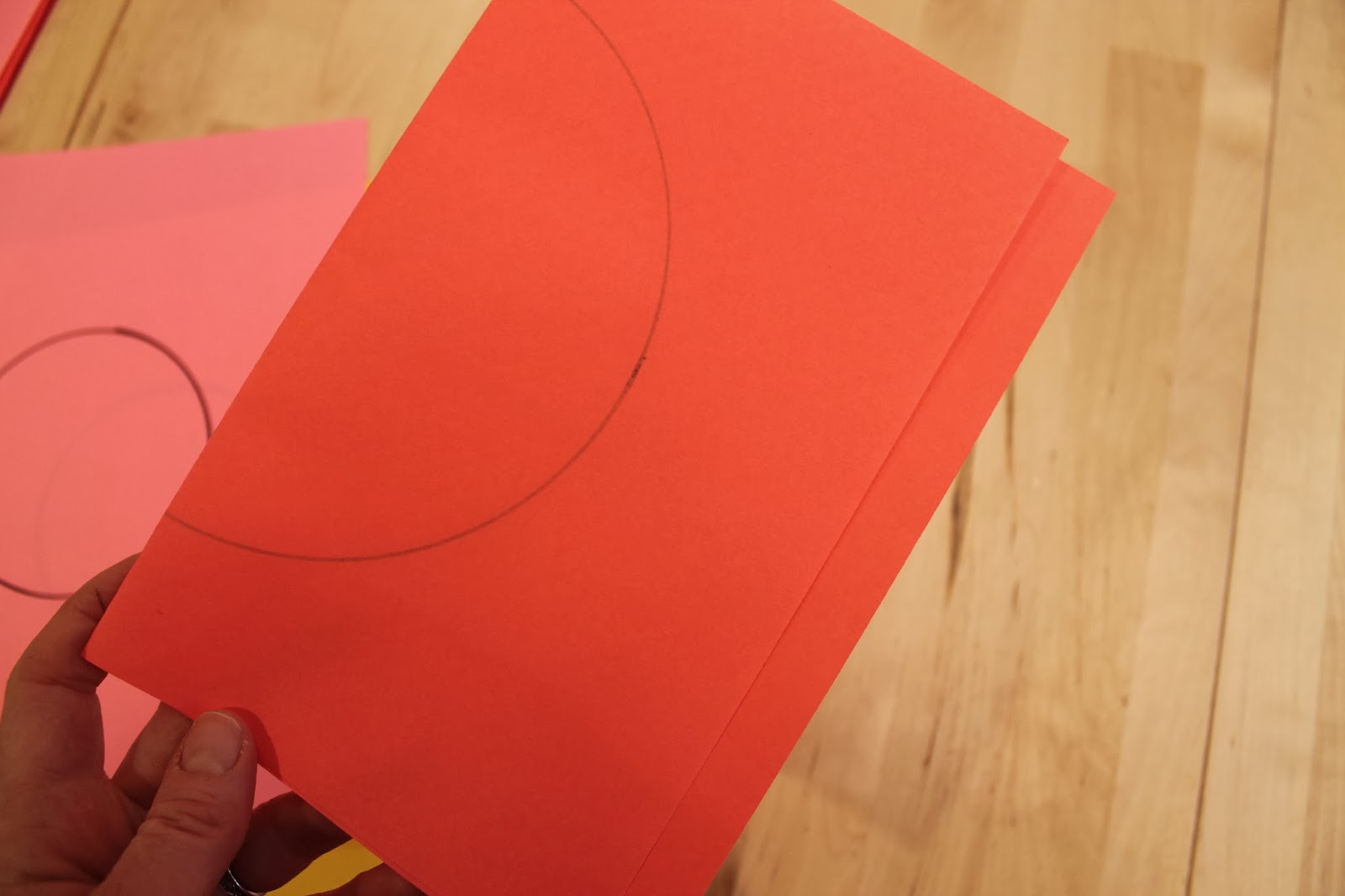
Beforehand, I traced circles of different sizes on paper, and I got out the pipe cleaners and cutting tool. Pipe cleaners don't stretch, and they can be bent into a nice arc shape, so they're preferable to yarn.


Then, I explained that the diameter of a circle is a line that goes through the middle of the circle and cuts it in half. We found the diameters by folding the circle in half, matching up opposite "edges" of the circle. (Math people, forgive me for my loose terminology. I was trying to speak at a kindergarten level.)

I had used black permanent marker, so we were able to see through the paper. That helped us fold the circles in half nicely.


Then we cut pipe cleaners to the length of each circle's diameter.


We saw that if we wanted to wrap the pipe cleaner all the way around the circle, it wouldn't be long enough. I demonstrated bending the pipe cleaner to fit the curve of the circle. I asked, "How many lengths of pipe cleaner would it take to go all the way around the circle?" Five-year-old Johnny guessed three.


We marked how many pipe cleaner lengths it took to go all the way around the circle. Johnny predicted that we would get the same result for each circle, no matter the size. Sure enough, for each circle, we got "three plus a little." We determined that the "little bit" was less than one half. (My husband had a fun time estimating the length of the extra bit by repeatedly folding the pipe cleaner, but that was over Johnny's head.)

We called our special number pi. Johnny immediately wanted to try a new way of counting: One, two, pi, three, four, five . . . We helped him figure out that pi is actually somewhere between three and four, not two and three.

The two-year-old was just happy that the whole family was doing something involving pipe cleaners. We gave him his own circle to hold.

When we were finished, we each had a slice of pie.